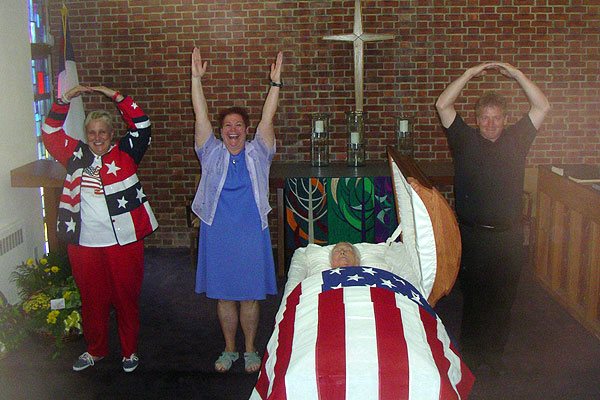
(Via Jonathan Chait's "Life in Ohio, a Continuing Series.")
Wednesday, August 31, 2011

Authors of note from the Paris Review blog
Jesmyn Ward, originally of De Lisle, Mississippi, has a new novel set on our Gulf Coast during Katrina, Salvage the Bones.
And Patricia Highsmith's biographer introduces us to a favorite writer of her subject's, Theodore Roosevelt's granddaughter, the novelist Theodora Keogh.
And Patricia Highsmith's biographer introduces us to a favorite writer of her subject's, Theodore Roosevelt's granddaughter, the novelist Theodora Keogh.
Keogh’s novels are mostly set in places she’d lived in intensely and knew by heart: the Upper East Side of New York, the Left Bank of Paris, the North Shore of Long Island.
Manhattan is a great beast in her New York books, prowling restively between vaguely tidal waters like a dragon getting ready to doss down for the night. She made her Paris quartier (our Paris quartier, since I live around the corner from where she wrote) come alive in visceral prose as the postwar terrain it was, throbbing with impermissible desires and criminal thoughts and centered on a street shaped, appropriately, like a goblet of wine.
A natural democrat, she enlivened her work with immigrants, foreign accents, and character actors from the underclasses. In two of her books, homosexuals are the major protagonists (The Double Door, The Other Girl). In others, beautiful women have affairs with underage boys or traduce their conventional husbands in states of magically-compelled trance (The Fascinator, The Mistress, My Name Is Rose).
She never stopped exploring the secrets of the flesh. In Meg (1950), the father of a twelve-year-old girl is magnetically drawn to his daughter’s best school friend—and that attraction is returned. A middle-aged music critic in Paris nearly abandons his new marriage for an eleven-year-old child criminal from the streets, and they kiss (Street Music). An entire Egyptian family falls in love with a chic New York model past her prime (The Mistress). Adult twins make love and suppress a murder (Gemini). A teenage heiress, kept apart from life like a princess in a tower, enters a secret door and sleeps with her father’s paid male lover (The Double Door).
Tuesday, August 30, 2011
Is Youngstown Sheet & Tube even on his final exams?
The Summer 2011 issue of the Mississippi Law Journal has an article by Lawrence Rosenthal, "Those Who Can’t, Teach: What the Legal Career of John Yoo Tells Us About Who Should Be Teaching Law." From his conclusion:
Whatever the value of creating within the academy repositories for theoretical scholarship unconnected to the practice of law, as we have seen, the vast majority of law students devote considerable time and money to law school on the understanding that they will obtain marketable skills. Surely law schools have some obligation to provide faculties capable of imparting those skills—-anything else is a species of consumer fraud. The fact that our leading law schools have on their faculties individuals who claim to be able to teach students to practice law, but in fact cannot provide their own clients with defensible legal advice and may well be incapable of teaching their students how to do so, suggests that something has gone very wrong in the legal academy.Check it out.
Obviously, the socialist rot began long ago
It was contended, in that case, just as here, that such an undertaking would be a complete departure from the concept of the forefathers and a step toward socialism; that, if this could be done, the State and its subdivisions could take over and operate every business and industry.A recent judicial opinion on the constitutionality of "Obamacare"? Or the Mississippi Supreme Court's 1961 summary of the losing side's arguments in Albritton v. City of Winona, a 1938 case in which the court upheld the city's acquisition of a "hosiery, knitting and wearing apparel manufacturing plant"?
In unrelated news, the State of Mississippi does not appear to have taken over and operated every business and industry within its bounds, nor does it seem to be particularly close to doing so.
Can't possibly be true
Some Jewish donors are telling fundraisers for Mitt Romney that while they like him, they'd rather open their wallets for the "Jewish candidate," Michele Bachmann, who they don't realize is actually a Lutheran, the New York Post reports.Via Political Wire.
"Some in Romney's camp have been wondering whether Bachmann and her allies are pushing the 'Jewish' rumor to help their own fund-raising... She has enjoyed strong popularity among Jewish voters and often talks about her stay on a kibbutz during the summer of 1974, when she was a teenager."
This demolishes numerous economic fairy tales about rational actors, not to mention stereotypes about how smart Jews are. Unless of course the Jewish donors are pulling Romney's leg, in accord with that other stereotype about how funny Jews are.
Monday, August 29, 2011
Your lyin' eyes
The New Jersey Supreme Court is revamping the admissibility of eyewitness identifications in criminal trials. The decision is here; remarkably, it's unanimous (130+ pages of unanimity). No time to read all that right now, but here's a quote from the syllabus:
(Via Drum.)
The Court directs that enhanced instructions be given to guide juries about the various factors that may affect the reliability of an identification in a particular case. Those instructions are to be included in the court’s comprehensive jury charge at the close of evidence. In addition, instructions may be given during trial if warranted. Expert testimony may also be introduced at trial, but only if otherwise appropriate. The Court anticipates, however, that with enhanced jury instructions, there will be less need for expert testimony. To help implement this decision, the Court asks the Criminal Practice Committee and the Committee on Model Criminal Jury Charges to draft proposed revisions to the current charge on eyewitness identification and submit them to this Court for review before they are implemented.Will other states follow?
(Via Drum.)
The bookshelf
Toby Wilkinson, The Rise and Fall of Ancient Egypt: It is weirdly difficult to go to the bookstore and find a narrative history of Egypt from Narmer to Cleopatra, and this book fills the gap. Strictly a political-military account, with literature and religion touched upon only in that context. Wilkinson flogs a bit more than necessary the fact that Egypt was not a liberal democracy, but it's worth being reminded how much suffering underlay those monuments and treasures. Also notable is that he does indeed carry the story past the decline of the New Kingdom up to the Romans, as a succession of regional badasses occupies Egypt.
P.A. Brunt, Social Conflicts in the Roman Republic: A short but influential sketch by Brunt, demonstrating that plebeian unrest was more than the backdrop to the politics of the Republic. I would rather have been reading Brunt's Fall of the Roman Republic, but that thing is over $200; Oxford U P seems squarely on the side of the optimates.
... Here's an interesting quote from Brunt's book:
P.A. Brunt, Social Conflicts in the Roman Republic: A short but influential sketch by Brunt, demonstrating that plebeian unrest was more than the backdrop to the politics of the Republic. I would rather have been reading Brunt's Fall of the Roman Republic, but that thing is over $200; Oxford U P seems squarely on the side of the optimates.
... Here's an interesting quote from Brunt's book:
By modern standards the ancient world was always poor and "under-developed." If any progress was to be made, it was inevitable that the majority should hew and carry in order that a very few might have the means and leisure to cultivate the arts and sciences. Even in democratic Athens property was unequally distributed; slave labour supported the wants of poets and philosophers and enabled quite humble citizens to devote some of their energy to war and government. Plato had said that in his day, the fourth century, every city was divided into the city of the rich and the city of the poor, just as Disraeli said that in nineteenth-century England there were "two nations." What distinguished Rome was neither economic inequality nor exploitation but the enormity in the scale of both. Whether or not this be deemed a fit matter for moral condemnation, the facts are of the highest historical importance, for revolution was to spring from the misery and resentment of the masses.Brunt's obituary in the Telegraph is also worth quoting:
He liked to tell the story of how he had once dozed off in the presence of an undergraduate, and woke to hear himself declaring: "No, that cannot be correct." He quickly asked his student to repeat the last two sentences of his essay, and was relieved to discover a flagrant errorRoland H. Bainton, Erasmus of Christendom: A good pop biography of a man too sensible for his times. May lead me to actually read my copy of The Praise of Folly.
Saturday, August 27, 2011
Oh, those repressive banana republics
Eugene Volokh posts on a prosecution in Saudi Arabia, where a critic of a religious figure posted numerous negative remarks on Twitter, blogs, etc. and has now been charged by national law enforcement with inflicting "substantial emotional distress" on the object of his opprobrium.
... Oh, sorry, did I say Saudi Arabia? My bad. It's the United States.
I seem to be in some parallel universe tonight, where the First Amendment doesn't exist, and where Detroit is up 17-3 in the 2d against New England. Mixed feelings about this dimension thus far.
... Oh, sorry, did I say Saudi Arabia? My bad. It's the United States.
I seem to be in some parallel universe tonight, where the First Amendment doesn't exist, and where Detroit is up 17-3 in the 2d against New England. Mixed feelings about this dimension thus far.
Friday, August 26, 2011
Quotes from the desktop
What a bitch of a thing prose is! It is never finished; there is always something to be done over.
-- Flaubert to Louise Colet, 1852
I was ruined only twice in my life: once when I lost a lawsuit, and once when I won one.
-- Voltaire
The invention of weights and measures makes robbery easier.
Signing contracts, setting seals, makes robbery more sure.
Teaching love and duty provides a fitting language with which to prove that robbery is really for the general good.
A poor man must swing for a belt buckle, but if a rich man steals a whole country, he is acclaimed as statesman of the year.
-- Chuang Tzu
... a man may live greatly in the law as well as elsewhere; there as well as elsewhere his thought may find its unity in an infinite perspective; there as well as elsewhere he may wreak himself upon life, may drink the bitter cup of heroism, may wear his heart out after the unattainable.
-- Oliver Wendell Holmes, Jr.
But freedom to differ is not limited to things that do not matter much. That would be a mere shadow of freedom. The test of its substance is the right to differ as to things that touch the heart of the existing order.
-- Robert Jackson, W. Va. Bd. of Educ. v. Barnette (1943)
-- Flaubert to Louise Colet, 1852
I was ruined only twice in my life: once when I lost a lawsuit, and once when I won one.
-- Voltaire
The invention of weights and measures makes robbery easier.
Signing contracts, setting seals, makes robbery more sure.
Teaching love and duty provides a fitting language with which to prove that robbery is really for the general good.
A poor man must swing for a belt buckle, but if a rich man steals a whole country, he is acclaimed as statesman of the year.
-- Chuang Tzu
... a man may live greatly in the law as well as elsewhere; there as well as elsewhere his thought may find its unity in an infinite perspective; there as well as elsewhere he may wreak himself upon life, may drink the bitter cup of heroism, may wear his heart out after the unattainable.
-- Oliver Wendell Holmes, Jr.
But freedom to differ is not limited to things that do not matter much. That would be a mere shadow of freedom. The test of its substance is the right to differ as to things that touch the heart of the existing order.
-- Robert Jackson, W. Va. Bd. of Educ. v. Barnette (1943)
Thursday, August 25, 2011
You say "General's," I say "General"?
So, what is that thing that one alternately praises or disparages, depending on whether it agrees with one's client's position -- an attorney general opinion, or an attorney general's opinion?
Garner's Dictionary of Modern Legal Usage appears silent on the question. 81 MSSC/COA opinions use "general" and 64 use "general's"; some, charmingly, use both: "Swan sought and obtained an Attorney General opinion. The Attorney General's opinion stated ...."
Turning to the ALLSTATES database in Westlaw and confining the search to 1980 and after, I get 1835 hits for the usage with the apostrophe "s" and 2956 for the usage without, not far from the MS-CS proportion.
... And if there's no apostrophe "s," then does "attorney general" take a hyphen? I'm going with "no," but more out of revulsion than logic.
... By analogy, one says "There's a supreme court opinion on point," not "a supreme court's opinion. But "The supreme court's opinion." Hm.
Here is the solution: "An opinion issued by the Attorney General's office (hereinafter 'AG Opinion') stated that ...."
Garner's Dictionary of Modern Legal Usage appears silent on the question. 81 MSSC/COA opinions use "general" and 64 use "general's"; some, charmingly, use both: "Swan sought and obtained an Attorney General opinion. The Attorney General's opinion stated ...."
Turning to the ALLSTATES database in Westlaw and confining the search to 1980 and after, I get 1835 hits for the usage with the apostrophe "s" and 2956 for the usage without, not far from the MS-CS proportion.
... And if there's no apostrophe "s," then does "attorney general" take a hyphen? I'm going with "no," but more out of revulsion than logic.
... By analogy, one says "There's a supreme court opinion on point," not "a supreme court's opinion. But "The supreme court's opinion." Hm.
Here is the solution: "An opinion issued by the Attorney General's office (hereinafter 'AG Opinion') stated that ...."
Monday, August 22, 2011
Georgia on my mind (alternative title: The Dullest Blog Post You May Ever Read)
TBA has been wrapped up in the day job lately, filing 3 briefs in 2 weeks. As loyal readers will recall, the vices of Times New Roman have weighed upon us, but we felt stuck with it because of its compactness and accessibility.
Here lately we've been using Georgia, which certain purists say is fine for the computer screen but not on paper. Call us unsophisticated, but we think it looks good either way. 12-pt Georgia uses little more space than 12-pt TNR, and less than the 13-pt TNR we were using in pleadings, while looking every bit as legible as the 13-pt TNR due to its taller x-height. It's noticeably different from TNR, but not so different as to give the impression I'm dialing in from a commune in the 9th Circuit.
Because Georgia was commissioned by Microsoft, it's about as ubiquitous as Arial (i.e., your computer probably has it pre-installed -- if you didn't want to pay $100 for a font). But the Evil Empire did well in this instance by its choice of designer, the talented Matthew Carter.
Try your next brief in Georgia and see how you like it!
...
Here lately we've been using Georgia, which certain purists say is fine for the computer screen but not on paper. Call us unsophisticated, but we think it looks good either way. 12-pt Georgia uses little more space than 12-pt TNR, and less than the 13-pt TNR we were using in pleadings, while looking every bit as legible as the 13-pt TNR due to its taller x-height. It's noticeably different from TNR, but not so different as to give the impression I'm dialing in from a commune in the 9th Circuit.
Because Georgia was commissioned by Microsoft, it's about as ubiquitous as Arial (i.e., your computer probably has it pre-installed -- if you didn't want to pay $100 for a font). But the Evil Empire did well in this instance by its choice of designer, the talented Matthew Carter.
Try your next brief in Georgia and see how you like it!
...
This sentence is a sample of Georgia per NMC in comments. My HTML code is changing the face but not the size, so for some reason it looks smaller; the effect on the page is that it looks larger than the corresponding size of Times New Roman.
(As you can see, I fixed the size problem.)Friday, August 19, 2011
These kids today just don't know the classics
If you haven't had the opportunity lately to wax curmudgeonly on the meretricious cultural tastes of the hoi polloi, this NPR readers' poll as to the top 100 SF/fantasy titles will do nicely.
For TBA's part, all we need to do is note the absence of Jack Vance.
... In faintly-related news, Obama buys the # 9 book on the list, no doubt to turn it into legislation once the Supreme Court affirms the dread insurance mandate:
For TBA's part, all we need to do is note the absence of Jack Vance.
... In faintly-related news, Obama buys the # 9 book on the list, no doubt to turn it into legislation once the Supreme Court affirms the dread insurance mandate:
President Obama made his first vacation visit with his daughters to a bookstore on Martha's Vineyard and was seen holding five or six books, including Brave New World and The Bayou Trilogy, according to the AP.I hadn't heard of Daniel Woodrell, but that Bayou Trilogy sounds pretty good.
"He went to the cashier after Malia and Sasha had picked out some books of their own, but disagreed with the $32 price he was quoted, which seemed low for the size of his stack. He paid by credit card, telling the cashiers that he uses it only about three times a year."
Also, one of your lunch entrees is poisoned -- let's see how smart you really are!
In Texas we teach both creationism and evolution, because I figure you’re smart enough to figure out which one’s right.-- Gov. Rick Perry, describing his state's cutting-edge educational technique of teaching students both truth and lies in order to discern which ones are intelligent enough to figure which is which.
... Evolution "has some gaps in it," Perry explained. As compared to ... creationism? General relativity? The standard model? The history of the U.S. as presented in Texas schoolrooms?
Tuesday, August 16, 2011
No help for Help maid
JJ reports that the author of The Help has won a defense verdict before Judge Green in Hinds Circuit Court, obtaining dismissal of the lawsuit by the alleged model for the family maid* in said novel. The intentional torts had a 1-year SOL and the plaintiff waited 2 years after publication to file suit.
... Kingfish posts Cooper's response opposing summary judgment on the SOL issue, in which she argues, literally, that she had a defense to SJ based on her judging the book by its cover. (See p. 5.) As Candace says on Phineas & Ferb, "that's why books have covers -- so you can judge them!" That theory does not seem to have availed in the present case.
(I do however confess to some curiosity how Cooper's claim for negligent infliction of emotional distress got dismissed, as it had a 3-year SOL; will have to watch the video of the hearing when time permits.)
... In other news, John McWhorter critiques the critics who complain that the movie is racist, insufficiently progressive, whatever.
____________________
* N.b. -- I haven't read the book or seen the movie, so I have no idea what I'm talking about.
... Kingfish posts Cooper's response opposing summary judgment on the SOL issue, in which she argues, literally, that she had a defense to SJ based on her judging the book by its cover. (See p. 5.) As Candace says on Phineas & Ferb, "that's why books have covers -- so you can judge them!" That theory does not seem to have availed in the present case.
(I do however confess to some curiosity how Cooper's claim for negligent infliction of emotional distress got dismissed, as it had a 3-year SOL; will have to watch the video of the hearing when time permits.)
... In other news, John McWhorter critiques the critics who complain that the movie is racist, insufficiently progressive, whatever.
____________________
* N.b. -- I haven't read the book or seen the movie, so I have no idea what I'm talking about.
Subscribe to:
Posts (Atom)